Like many medical translators, much of my work comes from clinical trials. This is a complex specialty with a lot of regulated terminology, yet in research it has traditionally received less attention than medical translation.
Another challenge commonly encountered within medical translation is the frequent use of abbreviations, which are often subject and location specific.
Over recent years there has been a lot of hype about AI in translation. As translators we are being encourage to keep up with the new technology or get left behind. Yet personally I hadn’t seen any evidence regarding the quality of its output.
Last year I designed a series of experiments to test different prompts to see just how accurate AI is at translating clinical trial abbreviations.
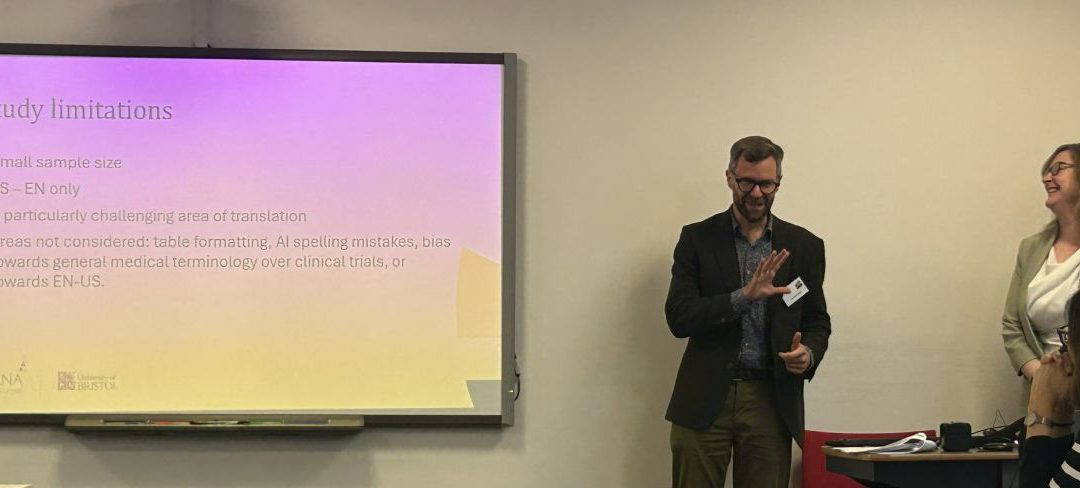
This was an exciting piece of research and, with the support of my amazing supervisor, Dr Christophe Fricker, we presented the results at The Association of Programmes in Translation and Interpreting Studies (APTIS) conference at Cardiff University in April.
So, should freelance translators invest time and money into learning how to prompt? Our research shows that simple prompts are more effective than complex ones, so the answer seems to be no.